

Before we begin, this is a long notebook, I suggest you to bookmark this and go through the material slowly, you have two weeks before I release the next chapter on Probability and Information Theory on 06.02.2019, so take your time. The best way to learn Linear Algebra is by visualizing the concepts, I tried to give practical examples and plots to help you visualize and as always, if you need more explanations, take it to the comments and I’ll get back to you.
So, Let’s begin 😈…
02.00 - Linear Algebra
Linear algebra is the branch of mathematics concerning linear equations and linear functions and their representations through matrices and vector spaces.
Machine Learning relies heavily on Linear Algebra, so it is essential to understand what vectors and matrices are, what operations you can perform with them, and how they can be useful.
If you are already familiar with linear algebra, feel free to skip this chapter but note that the implementation of certain functions are different between Tensorflow 1.0 and Tensorflow 2.0 so you should atleast skim through the code.
If you have had no exposure at all to linear algebra, this chapter will teach you enough to read this book.
# Installs!pip install --upgrade tf-nightly-2.0-preview
# Importsimport tensorflow as tfimport sysimport numpy as npimport matplotlib.pyplot as pltimport pandas as pd
"""If you are running this notebook in Google colab, make sure to upload the helpers.py file to yoursession before running it, but if you are running this in Binder, then youdon't have to worry about it. The helpers.py file will be in the notebookfolder in GitHub.
"""from helpers import vector_plot, plot_transform
02.01 - Scalars, Vectors, Matrices and Tensors
Scalars: are just a single number. For example temperature, which is denoted by just one number.
Vectors: are an array of numbers. The numbers are arranged in order and we can identify each individual number by its index in that ordering. We can think of vectors as identifying points in space, with each element giving the coordinate along a different axis. In simple terms, a vector is an arrow representing a quantity that has both magnitude and direction wherein the length of the arrow represents the magnitude and the orientation tells you the direction. For example wind, which has a direction and magnitude.
Matrices: A matrix is a 2D-array of numbers, so each element is identified by two indices instead of just one. If a real valued matrix has a height of m and a width of n, then we say that
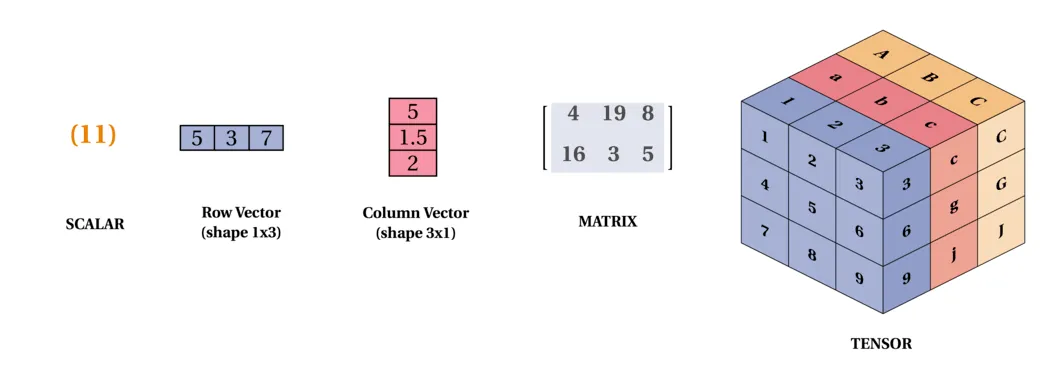
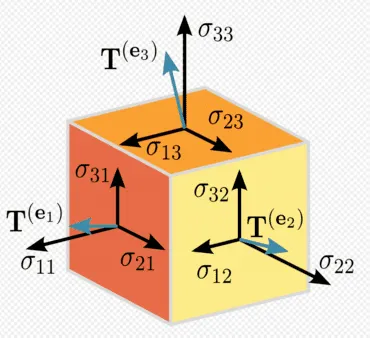
Tensors: In the general case, are an array of numbers arranged on a regular grid with a variable number of axes is knows as a tensor. We identify the elements of a tensor at coordinates(i, j, k) by writing
We can add matrices to each other as long as they have the same shape, just by adding their corresponding elements:
If you have trouble viewing the equations in the browser you can also read the chapter in Jupyter nbviewer in its entirety. If not, let’s continue.
In tensorflow a:
- Rank 0 Tensor is a Scalar
- Rank 1 Tensor is a Vector
- Rank 2 Tensor is a Matrix
- Rank 3 Tensor is a 3-Tensor
- Rank n Tensor is a n-Tensor
# let's create a ones 3x3 rank 2 tensorrank_2_tensor_A = tf.ones([3, 3], name='MatrixA')print("3x3 Rank 2 Tensor A: \n{}\n".format(rank_2_tensor_A))
# let's manually create a 3x3 rank two tensor and specify the data type as floatrank_2_tensor_B = tf.constant([[1, 2, 3], [4, 5, 6], [7, 8, 9]], name='MatrixB', dtype=tf.float32)print("3x3 Rank 2 Tensor B: \n{}\n".format(rank_2_tensor_B))
# addition of the two tensorsrank_2_tensor_C = tf.add(rank_2_tensor_A, rank_2_tensor_B, name='MatrixC')print("Rank 2 Tensor C with shape={} and elements: \n{}".format(rank_2_tensor_C.shape, rank_2_tensor_C))
Toggle to see results
3x3 Rank 2 Tensor A:[[1. 1. 1.] [1. 1. 1.] [1. 1. 1.]]
3x3 Rank 2 Tensor B:[[1. 2. 3.] [4. 5. 6.] [7. 8. 9.]]
Rank 2 Tensor C with shape=(3, 3) and elements:[[ 2.  3.  4.] [ 5.  6.  7.] [ 8.  9. 10.]]
# Let's see what happens if the shapes are not the sametwo_by_three = tf.ones([2, 3])try: incompatible_tensor = tf.add(two_by_three, rank_2_tensor_B)except: print("""Incompatible shapes to add with two_by_three of shape {0} and 3x3 Rank 2 Tensor B of shape {1} """.format(two_by_three.shape, rank_2_tensor_B.shape))Toggle to see results
Incompatible shapes to add with two_by_three of shape (2, 3) and 3x3 Rank 2 Tensor B of shape (3, 3)We can also add a scalar to a matrix or multiply a matrix by a scalar, just by performing that operation on each element of a matrix:
# Create scalar a, c and Matrix Brank_0_tensor_a = tf.constant(2, name="scalar_a", dtype=tf.float32)rank_2_tensor_B = tf.constant([[1, 2, 3], [4, 5, 6], [7, 8, 9]], name='MatrixB', dtype=tf.float32)rank_0_tensor_c = tf.constant(3, name="scalar_c", dtype=tf.float32)
# multiplying aBmultiply_scalar = tf.multiply(rank_0_tensor_a, rank_2_tensor_B)# adding aB + crank_2_tensor_D = tf.add(multiply_scalar, rank_0_tensor_c, name="MatrixD")
print("""Original Rank 2 Tensor B: \n{0} \n\nScalar a: {1}Rank 2 Tensor for aB: \n{2} \n\nScalar c: {3} \nRank 2 Tensor D = aB + c: \n{4}""".format(rank_2_tensor_B, rank_0_tensor_a, multiply_scalar, rank_0_tensor_c, rank_2_tensor_D))
Toggle to see results
Original Rank 2 Tensor B:[[1. 2. 3.] [4. 5. 6.] [7. 8. 9.]]
Scalar a: 2.0Rank 2 Tensor for aB:[[ 2.  4.  6.] [ 8. 10. 12.] [14. 16. 18.]]
Scalar c: 3.0Rank 2 Tensor D = aB + c:[[ 5.  7.  9.] [11. 13. 15.] [17. 19. 21.]]
One important operation on matrices is the transpose. The transpose of a matrix is the mirror image of the matrix across a diagonal line, called the main diagonal. We denote the transpose of a matrix as
# Creating a Matrix Erank_2_tensor_E = tf.constant([[1, 2, 3], [4, 5, 6]])# Transposing Matrix Etranspose_E = tf.transpose(rank_2_tensor_E, name="transposeE")
print("""Rank 2 Tensor E of shape: {0} and elements: \n{1}\nTranspose of Rank 2 Tensor E of shape: {2} and elements: \n{3}""".format(rank_2_tensor_E.shape, rank_2_tensor_E, transpose_E.shape, transpose_E))
Toggle to see results
Rank 2 Tensor E of shape: (2, 3) and elements:[[1 2 3] [4 5 6]]
Transpose of Rank 2 Tensor E of shape: (3, 2) and elements:[[1 4] [2 5] [3 6]]
In deep learning we allow the addition of matrix and a vector, yielding another matrix where . In other words, the vector is added to each row of the matrix. This implicit copying of to many locations is called broadcasting
# Creating a vector brank_1_tensor_b = tf.constant([[4.], [5.], [6.]])# Broadcasting a vector b to a matrix A such that it yields a matrix F = A + brank_2_tensor_F = tf.add(rank_2_tensor_A, rank_1_tensor_b, name="broadcastF")
print("""Rank 2 tensor A: \n{0}\n \nRank 1 Tensor b: \n{1}\nRank 2 tensor F = A + b:\n{2}""".format(rank_2_tensor_A, rank_1_tensor_b, rank_2_tensor_F))
Toggle to see results
Rank 2 tensor A:[[1. 1. 1.] [1. 1. 1.] [1. 1. 1.]]
Rank 1 Tensor b:[[4.] [5.] [6.]]
Rank 2 tensor F = A + b:[[5. 5. 5.] [6. 6. 6.] [7. 7. 7.]]
02.02 - Multiplying Matrices and Vectors
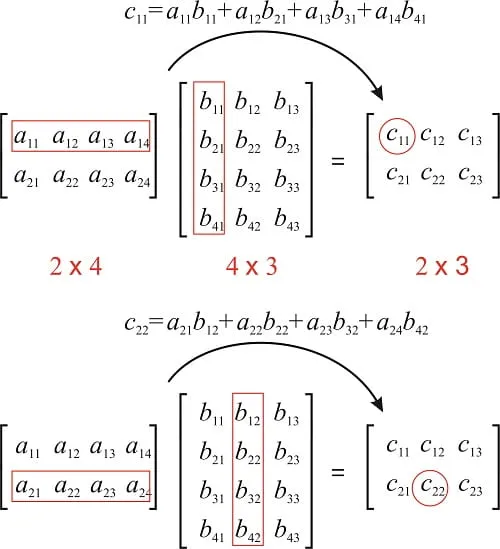
To define the matrix product of matrices must have the same number of columns as . If is of shape m x n and is of shape n x p, then is of shape m x p.
If you do not recall how matrix multiplication is performed, take a look at:
# Matrix A and B with shapes (2, 3) and (3, 4)mmv_matrix_A = tf.ones([2, 3], name="matrix_A")mmv_matrix_B = tf.constant([[1, 2, 3, 4], [1, 2, 3, 4], [1, 2, 3, 4]], name="matrix_B", dtype=tf.float32)
# Matrix Multiplication: C = AB with C shape (2, 4)matrix_multiply_C = tf.matmul(mmv_matrix_A, mmv_matrix_B, name="matrix_multiply_C")
print("""Matrix A: shape {0} \nelements: \n{1} \n\nMatrix B: shape {2} \nelements: \n{3}\nMatrix C: shape {4} \nelements: \n{5}""".format(mmv_matrix_A.shape, mmv_matrix_A, mmv_matrix_B.shape, mmv_matrix_B, matrix_multiply_C.shape, matrix_multiply_C))
Toggle to see results
Matrix A: shape (2, 3)elements:[[1. 1. 1.] [1. 1. 1.]]
Matrix B: shape (3, 4)elements:[[1. 2. 3. 4.] [1. 2. 3. 4.] [1. 2. 3. 4.]]
Matrix C: shape (2, 4)elements:[[ 3.  6.  9. 12.] [ 3.  6.  9. 12.]]
To get a matrix containing the product of the individual elements, we use element wise product or Hadamard product and is denoted as .
"""Note that we use multiply to do element wise matrix multiplication and matmulto do matrix multiplication"""# Creating new Matrix A and B with shapes (3, 3)element_matrix_A = tf.ones([3, 3], name="element_matrix_A")element_matrix_B = tf.constant([[1, 2, 3], [4, 5, 6], [7, 8, 9]], name="element_matrix_B", dtype=tf.float32)
# Element wise multiplication of Matrix A and Belement_wise_C = tf.multiply(element_matrix_A, element_matrix_B, name="element_wise_C")
print("""Matrix A: shape {0} \nelements: \n{1} \n\nMatrix A: shape {2} \nelements: \n{3}\nMatrix C: shape {4} \nelements: \n{5}""".format(element_matrix_A.shape, element_matrix_A, element_matrix_B.shape, element_matrix_B, element_wise_C.shape, element_wise_C))
Toggle to see results
Matrix A: shape (3, 3)elements:[[1. 1. 1.] [1. 1. 1.] [1. 1. 1.]]
Matrix A: shape (3, 3)elements:[[1. 2. 3.] [4. 5. 6.] [7. 8. 9.]]
Matrix C: shape (3, 3)elements:[[1. 2. 3.] [4. 5. 6.] [7. 8. 9.]]
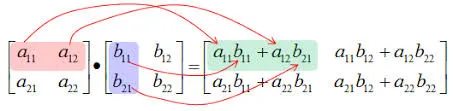
To compute the dot product between and we compute as the dot product between row i of and column j of .
# Creating Matrix A and B with shapes (3, 3)dot_matrix_A = tf.ones([3, 3], name="dot_matrix_A")dot_matrix_B = tf.constant([[1, 2, 3], [4, 5, 6], [7, 8, 9]], name="dot_matrix_B", dtype=tf.float32)
# Dot product of A and Bdot_product_C = tf.tensordot(dot_matrix_A, dot_matrix_B, axes=1, name="dot_product_C")
print("""Matrix A: shape {0} \nelements: \n{1} \n\nMatrix B: shape {2} \nelements: \n{3}\nMatrix C: shape {4} \nelements: \n{5}""".format(dot_matrix_A.shape, dot_matrix_A, dot_matrix_B.shape, dot_matrix_B, dot_product_C.shape, dot_product_C))
Toggle to see results
Matrix A: shape (3, 3)elements:[[1. 1. 1.] [1. 1. 1.] [1. 1. 1.]]
Matrix B: shape (3, 3)elements:[[1. 2. 3.] [4. 5. 6.] [7. 8. 9.]]
Matrix C: shape (3, 3)elements:[[12. 15. 18.] [12. 15. 18.] [12. 15. 18.]]
Some properties of matrix multiplication (Distributive Property):
# Common Matrices to check all the matrix Propertiesmatrix_A = tf.constant([[1, 2], [3, 4]], name="matrix_a")matrix_B = tf.constant([[5, 6], [7, 8]], name="matrix_b")matrix_C = tf.constant([[9, 1], [2, 3]], name="matrix_c")# Distributive Propertyprint("Matrix A: \n{} \n\nMatrix B: \n{} \n\nMatrix C: \n{}\n".format(matrix_A, matrix_B, matrix_C))
# AB + ACdistributive_RHS = tf.add(tf.matmul(matrix_A, matrix_B), tf.matmul(matrix_A, matrix_C), name="RHS")
# A(B+C)distributive_LHS = tf.matmul(matrix_A, (tf.add(matrix_B, matrix_C)), name="LHS")
"""Following is another way a conditional statement can be implemented from tensorflowThis might not seem very useful now but I want to introduce it here so you canfigure out how it works for a simple example."""# To compare each element in the matrix, you need to reduce it first and check if it's equalpredictor = tf.reduce_all(tf.equal(distributive_RHS, distributive_LHS))
# condition to act on if predictor is Truedef true_print(): print("""Distributive property is validRHS: AB + AC: \n{} \n\nLHS: A(B+C): \n{}""".format(distributive_RHS, distributive_LHS))
# condition to act on if predictor is Falsedef false_print(): print("""You Broke the Distributive Property of MatrixRHS: AB + AC: \n{} \n\nis NOT Equal to LHS: A(B+C): \n{}""".format(distributive_RHS, distributive_LHS))
tf.cond(predictor, true_print, false_print)Toggle to see results
Matrix A:[[1 2] [3 4]]
Matrix B:[[5 6] [7 8]]
Matrix C:[[9 1] [2 3]]
Distributive property is validRHS: AB + AC:[[32 29] [78 65]]
LHS: A(B+C):[[32 29] [78 65]]
Some properties of matrix multiplication (Associative property):
# Associative propertyprint("Matrix A: \n{} \n\nMatrix B: \n{} \n\nMatrix C: \n{}\n".format(matrix_A, matrix_B, matrix_C))
# (AB)Cassociative_RHS = tf.matmul(tf.matmul(matrix_A, matrix_B), matrix_C)
# A(BC)associative_LHS = tf.matmul(matrix_A, tf.matmul(matrix_B, matrix_C))
# To compare each element in the matrix, you need to reduce it first and check if it's equalpredictor = tf.reduce_all(tf.equal(associative_RHS, associative_LHS))
# condition to act on if predictor is Truedef true_print(): print("""Associative property is validRHS: (AB)C: \n{} \n\nLHS: A(BC): \n{}""".format(associative_RHS, associative_LHS))
# condition to act on if predictor is Falsedef false_print(): print("""You Broke the Associative Property of MatrixRHS: (AB)C: \n{} \n\nLHS: A(BC): \n{}""".format(associative_RHS, associative_LHS))
tf.cond(predictor, true_print, false_print)
Toggle to see results
Matrix A:[[1 2] [3 4]]
Matrix B:[[5 6] [7 8]]
Matrix C:[[9 1] [2 3]]
Associative property is validRHS: (AB)C:[[215  85] [487 193]]
LHS: A(BC):[[215  85] [487 193]]
Some properties of matrix multiplication (Matrix multiplication is not commutative):
# Matrix multiplication is not commutativeprint("Matrix A: \n{} \n\nMatrix B: \n{}\n".format(matrix_A, matrix_B))
# Matrix A times Bcommutative_RHS = tf.matmul(matrix_A, matrix_B)
# Matrix B times Acommutative_LHS = tf.matmul(matrix_B, matrix_A)
predictor = tf.logical_not(tf.reduce_all(tf.equal(commutative_RHS, commutative_LHS)))def true_print(): print("""Matrix Multiplication is not commutativeRHS: (AB): \n{} \n\nLHS: (BA): \n{}""".format(commutative_RHS, commutative_LHS))
def false_print(): print("""You made Matrix Multiplication commutativeRHS: (AB): \n{} \n\nLHS: (BA): \n{}""".format(commutative_RHS, commutative_LHS))
tf.cond(predictor, true_print, false_print)
Toggle to see results
Matrix A:[[1 2] [3 4]]
Matrix B:[[5 6] [7 8]]
Matrix Multiplication is not commutativeRHS: (AB):[[19 22] [43 50]]
LHS: (BA):[[23 34] [31 46]]
Some properties of matrix multiplication (Transpose):
# Transpose of a matrixprint("Matrix A: \n{} \n\nMatrix B: \n{}\n".format(matrix_A, matrix_B))
# Tensorflow transpose functiontranspose_RHS = tf.transpose(tf.matmul(matrix_A, matrix_B))
# If you are doing matrix multiplication tf.matmul has a parameter to take the tranpose and then matrix multiplytranspose_LHS = tf.matmul(matrix_B, matrix_A, transpose_a=True, transpose_b=True)
predictor = tf.reduce_all(tf.equal(transpose_RHS, transpose_LHS))def true_print(): print("""Transpose property is validRHS: (AB):^T \n{} \n\nLHS: (B^T A^T): \n{}""".format(transpose_RHS, transpose_LHS))
def false_print(): print("""You Broke the Transpose Property of MatrixRHS: (AB):^T \n{} \n\nLHS: (B^T A^T): \n{}""".format(transpose_RHS, transpose_LHS))
tf.cond(predictor, true_print, false_print)
Toggle to see results
Matrix A:[[1 2][3 4]]
Matrix B:[[5 6] [7 8]]
Transpose property is validRHS: (AB):^T[[19 43] [22 50]]
LHS: (B^T A^T):[[19 43] [22 50]]
02.03 - Identity and Inverse Matrices
Linear algebra offers a powerful tool called matrix inversion that enables us to analytically solve for many values of .
To describe matrix inversion, we first need to define the concept of an identity matrix. An identity matrix is a matrix that does not change any vector when we multiply that vector by that matrix.
Such that:
The structure of the identity matrix is simple: all the entries along the main diagonal are 1, while all the other entries are zero.
# let's create a identity matrix Iidentity_matrix_I = tf.eye(3, 3, dtype=tf.float32, name='IdentityMatrixI')print("Identity matrix I: \n{}\n".format(identity_matrix_I))
# let's create a 3x1 vector xiim_vector_x = tf.constant([[4], [5], [6]], name='Vector_x', dtype=tf.float32)print("Vector x: \n{}\n".format(iim_vector_x))
# Ix will result in xiim_matrix_C = tf.matmul(identity_matrix_I, iim_vector_x, name='MatrixC')print("Matrix C from Ix: \n{}".format(iim_matrix_C))
Toggle to see results
Identity matrix I:[[1. 0. 0.] [0. 1. 0.] [0. 0. 1.]]
Vector x:[[4.] [5.] [6.]]
Matrix C from Ix:[[4.] [5.] [6.]]
The matrix inverse of is denoted as , and it is defined as the matrix such that:
iim_matrix_A = tf.constant([[2, 3], [2, 2]], name='MatrixA', dtype=tf.float32)
try:    # Tensorflow function to take the inverse    inverse_matrix_A = tf.linalg.inv(iim_matrix_A)
    # Creating a identity matrix using tf.eye    identity_matrix = tf.eye(2, 2, dtype=tf.float32, name="identity")
    iim_RHS = identity_matrix    iim_LHS = tf.matmul(inverse_matrix_A, iim_matrix_A, name="LHS")
    predictor = tf.reduce_all(tf.equal(iim_RHS, iim_LHS))    def true_print(): print("""A^-1 times A equals the Identity MatrixMatrix A: \n{0} \n\nInverse of Matrix A: \n{1} \n\nRHS: I: \n{2} \n\nLHS: A^(-1) A: \n{3}""".format(iim_matrix_A, inverse_matrix_A, iim_RHS, iim_LHS))    def false_print(): print("Condition Failed")    tf.cond(predictor, true_print, false_print)
except:    print("""A^-1 doesnt exist    Matrix A: \n{} \n\nInverse of Matrix A: \n{} \n\nRHS: I: \n{}    \nLHS: (A^(-1) A): \n{}""".format(iim_matrix_A, inverse_matrix_A, iim_RHS, iim_LHS))
Toggle to see results
A^-1 times A equals the Identity MatrixMatrix A:[[2. 3.] [2. 2.]]
Inverse of Matrix A:[[-1.   1.5] [ 1.  -1. ]]
RHS: I:[[1. 0.] [0. 1.]]
LHS: A^(-1) A:[[1. 0.] [0. 1.]]
If you try different values for Matrix A, you will see that, not all has an inverse and we will discuss the conditions for the existence of in the following section.
We can then solve the equation as:
This process depends on it being possible to find .
We can calculate the inverse of a matrix by:
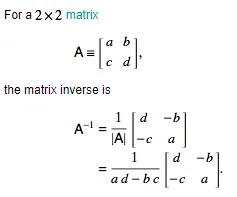
Lets see how we can solve a simple linear equation: 2x + 3y = 6 and 4x + 9y = 15
# The above system of equation can be written in the matrix format as:sys_matrix_A = tf.constant([[2, 3], [4, 9]], dtype=tf.float32)sys_vector_B = tf.constant([[6], [15]], dtype=tf.float32)print("Matrix A: \n{} \n\nVector B: \n{}\n".format(sys_matrix_A, sys_vector_B))
# now to solve for x: x = A^(-1)bsys_x = tf.matmul(tf.linalg.inv(sys_matrix_A), sys_vector_B)print("Vector x is: \n{} \nWhere x = {} and y = {}".format(sys_x, sys_x[0], sys_x[1]))
Toggle to see results
Matrix A:[[2. 3.] [4. 9.]]
Vector B:[[ 6.] [15.]]
Vector x is:[[1.5] [1. ]]Where x = [1.5] and y = [1.]
02.04 - Linear Dependence and Span
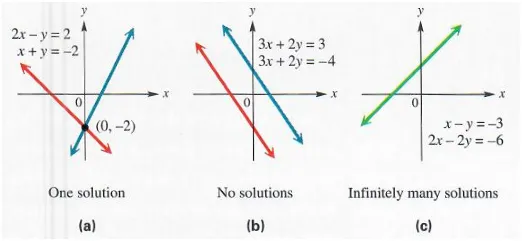
For to exits, must have exactly one solution for every value of . It is also possible for the system of equations to have no solutions or infinitely many solutions for some values of . This is simply because we are dealing with linear systems and two lines can’t cross more than once. So, they can either cross once, cross never, or have infinite crossing, meaning the two lines are superimposed.
Hence if both and are solutions then:
is also a solution for any real
The span of a set of vectors is the set of all linear combinations of the vectors. Formally, a linear combination of some set of vectors is given by multiplying each vecor by a corresponding scalar coefficient and adding the results:
Determining whether has a solution thus amounts to testing whether is in the span of the columns of . This particular span is known as the column space or the range, of .
In order for the system to have a solution for all values of , we require that the column space of be all of .
A set of vectors is linearly independent if the only solution to the vector equation . If a set of vectors is not linearly independent, then it is linearly dependent.
For the matrix to have an inverse, the matrix must be square, that is, we require that m = n and that all the columns be linearly independent. A square matrix with linearly dependent columns is known as singular.
If is not square or is square but singular, solving the equation is still possible, but we cannot use the method of matrix inversion to find the solution.
So far we have discussed matrix inverses as being multiplied on the left. It is also possible to define an inverse that is multiplied on the right. For square matrixes, the left inverse and right inverse are equal.
# Lets start by finding for some value of A and x, what the result of x islds_matrix_A = tf.constant([[3, 1], [1, 2]], name='MatrixA', dtype=tf.float32)lds_vector_x = tf.constant([2, 3], name='vectorX', dtype=tf.float32)lds_b = tf.multiply(lds_matrix_A, lds_vector_x, name="b")
# Now let's see if an inverse for Matrix A existstry:    inverse_A = tf.linalg.inv(lds_matrix_A)    print("Matrix A is successfully inverted: \n{}".format(inverse_A))except:    print("Inverse of Matrix A: \n{} \ndoesn't exist. ".format(lds_matrix_A))
# Let's find the value of x using x = A^(-1)bverify_x = tf.matmul(inverse_A, lds_b, name="verifyX")predictor = tf.equal(lds_vector_x[0], verify_x[0][0]) and tf.equal(lds_vector_x[1], verify_x[1][1])
def true_print(): print("""\nThe two x values match, we proved that if a matrix A is invertibleThen x = A^T b, \nwhere x: {}, \n\nA^T: \n{}, \n\nb: \n{}""".format(lds_vector_x, inverse_A, lds_b))
def false_print(): print("""\nThe two x values don't match.Vector x: {} \n\nA^(-1)b: \n{}""".format(lds_vector_x, verify_x))
tf.cond(predictor, true_print, false_print)
Toggle to see results
Matrix A is successfully inverted:[[ 0.40000004 -0.20000002] [-0.20000002  0.6       ]]
The two x values match, we proved that if a matrix A is invertibleThen x = A^T b,where x: [2. 3.],
A^T:[[ 0.40000004 -0.20000002] [-0.20000002  0.6       ]],
b:[[6. 3.] [2. 6.]]
Note that, finding inverses can be a challenging process if you want to calculate it, but using tensorflow or any other library, you can easily check if the inverse of the matrix exists. If you know the conditions and know how to solve matrix equations using tensorflow, you should be good, but for the reader who wants to go deeper, check Linear Dependence and Span for further examples and definitions.
02.05 - Norms
In machine learning if we need to measure the size of vectors, we use a function called a norm. And norm is what is generally used to evaluate the error of a model. Formally, the norm is given by:
for
On an intuitive level, the norm of a vector measures the distance from the origin to the point .
More rigorously, a norm is any function that satisfies the following properties:
The norm with p=2 is known as the Euclidean norm. Which is simply the Euclidean distance from the origin to the point identified by . It is also common to measure the size of a vector using the squared norm, which can be calculated simply as
# Euclidean distance between square root(3^2 + 4^2) calculated by setting ord='euclidean'dist_euclidean = tf.norm([3., 4.], ord='euclidean')print("Euclidean Distance: {}".format(dist_euclidean))
# Size of the vector [3., 4.]vector_size = tf.multiply(tf.transpose([3., 4.]), [3., 4.])print("Vector Size: {}".format(vector_size))
Toggle to see results
Euclidean Distance: 5.0Vector Size: [ 9. 16.]In many contexts, the squared norm may be undesirable, because it increases very slowly near the origin. In many machine learning applications, it is important to discriminate between elements that are exactly zero and elements that are small but nonzero. In these cases, we turn to a function that grows at the same rate in all locations, but retains mathematical simplicity: the norm, which can be simplified to:
def SE(x,y,intc,beta):    return (1./len(x))*(0.5)*sum(y - beta * x - intc)**2
def L1(intc,beta,lam):    return lam*(tf.abs(intc) + tf.abs(beta))
def L2(intc,beta,lam):    return lam*(intc**2 + beta**2)
N = 100x = np.random.randn(N)y = 2 * x + np.random.randn(N)
beta_N = 100beta = tf.linspace(-100., 100., beta_N)intc = 0.0
SE_array = np.array([SE(x,y,intc,i) for i in beta])L1_array = np.array([L1(intc,i,lam=30) for i in beta])L2_array = np.array([L2(intc,i,lam=1) for i in beta])
fig1 = plt.figure()ax1 = fig1.add_subplot(1,1,1)ax1.plot(beta, SE_array, label='Squared L2 Norm')ax1.plot(beta, L1_array, label='L1 norm')ax1.plot(beta, L2_array, label='L2 norm')plt.rc_context({'axes.edgecolor':'orange', 'xtick.color':'red', 'ytick.color':'red'})plt.title('The graph of each of the norms', color='w')plt.legend()fig1.show()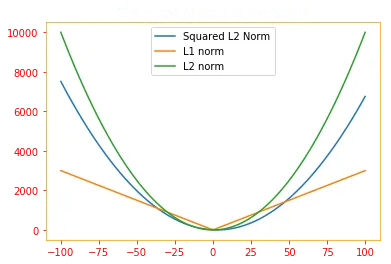
One other norm that commonly arises in machine learning is the
If we wish to measure the size of a matrix, in context of deep learning, the most common way to do this is with the Frobenius norm:
which is analogous to the norm of a vector.
Meaning for example for a matrix:
n_matrix_A = tf.constant([[2, -1, 5], [0, 2, 1], [3, 1, 1]], name="matrix_A", dtype=tf.float32)
# Frobenius norm for matrix calculated by setting ord='fro'frobenius_norm = tf.norm(n_matrix_A, ord='fro', axis=(0, 1))print("Frobenius norm: {}".format(frobenius_norm))
Toggle to see results
Frobenius norm: 6.78233003616333The dot product of two vectors can be rewritten in terms of norms as:
where is the angle between and .
# for x(0, 2) and y(2, 2) cos theta = 45 degreesn_vector_x = tf.constant([[0], [2]], dtype=tf.float32, name="vectorX")n_vector_y = tf.constant([[2], [2]], dtype=tf.float32, name="vectorY")
# Due to pi being in, we won't get an exact value so we are rounding our final valueprod_RHS = tf.round(tf.multiply(tf.multiply(tf.norm(n_vector_x), tf.norm(n_vector_y)), tf.cos(np.pi/4)))prod_LHS = tf.tensordot(tf.transpose(n_vector_x), n_vector_y, axes=1, name="LHS")
predictor = tf.equal(prod_RHS, prod_LHS)def true_print(): print("""Dot Product can be rewritten in terms of norms, where \nRHS: {} \nLHS: {}""".format(prod_RHS, prod_LHS))
def false_print(): print("""Dot Product can not be rewritten in terms of norms, where \nRHS: {} \nLHS: {}""".format(prod_RHS, prod_LHS))
tf.cond(predictor, true_print, false_print)
origin=[0,0]plt.rc_context({'axes.edgecolor':'orange', 'xtick.color':'red', 'ytick.color':'red'})plt.xlim(-2, 10)plt.ylim(-1, 10)plt.axvline(x=0, color='grey', zorder=0)plt.axhline(y=0, color='grey', zorder=0)plt.text(-1, 2, r'$\vec{x}$', size=18)plt.text(2, 1.5, r'$\vec{y}$', size=18)plt.quiver(*origin, n_vector_x, n_vector_y, color=['#FF9A13','#1190FF'], scale=8)plt.show()
Toggle to see results
Dot Product can be rewritten in terms of norms, whereRHS: 4.0LHS: [[4.]]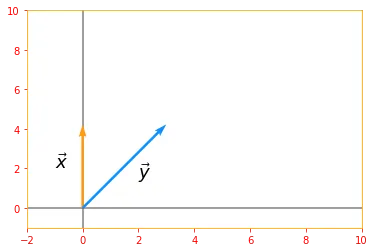
Stay in the loop
Notes from the trenches on building, scaling, and shipping production ML systems.
Occasional emails. Only when there's something worth sharing.
02.06 - Special Kinds of Matrices and Vectors
Diagonal matrices consist mostly of zeros and have nonzero entries only along the main diagonal. Identity matrix is an example of diagonal matrix. We write to denote a square diagonal matrix whose diagonal entries are given by the entries of the vector v.
To compute we only need to scale each element by . In other words:
# create vector v and xsp_vector_v = tf.random.uniform([5], minval=0, maxval=10, dtype = tf.int32, seed = 0, name="vector_v")sp_vector_x = tf.random.uniform([5], minval=0, maxval=10, dtype = tf.int32, seed = 0, name="vector_x")print("Vector v: {} \nVector x: {}\n".format(sp_vector_v, sp_vector_x))
# RHS diagonal vector v dot diagonal vector x. The linalg.diag converts a vector to a diagonal matrixsp_RHS = tf.tensordot(tf.linalg.diag(sp_vector_v), tf.linalg.diag(sp_vector_x), axes=1)
# LHS diag(v)xsp_LHS = tf.multiply(tf.linalg.diag(sp_vector_v), sp_vector_x)
predictor = tf.reduce_all(tf.equal(sp_RHS, sp_LHS))def true_print(): print("Diagonal of v times x: \n{} \n\nis equal to vector v dot vector x: \n{}".format(sp_RHS, sp_LHS))def false_print(): print("Diagonal of v times x: \n{} \n\nis NOT equal to vector v dot vector x: \n{}".format(sp_RHS, sp_LHS))
tf.cond(predictor, true_print, false_print)
Toggle to see results
Vector v: [1 3 8 5 3]Vector x: [9 0 4 1 4]
Diagonal of v times x:[[ 9  0  0  0  0] [ 0  0  0  0  0] [ 0  0 32  0  0] [ 0  0  0  5  0] [ 0  0  0  0 12]]
is equal to vector v dot vector x:[[ 9  0  0  0  0] [ 0  0  0  0  0] [ 0  0 32  0  0] [ 0  0  0  5  0] [ 0  0  0  0 12]]
Inverting a square diagonal matrix is also efficient. The inverse exists only if every diagonal entry is nonzero, and in that case:
try:    # try creating a vector_v with zero elements and see what happens    d_vector_v = tf.random.uniform([5], minval=1, maxval=10, dtype = tf.float32, seed = 0, name="vector_v")    print("Vector v: {}".format(d_vector_v))
    # linalg.diag converts a vector to a diagonal matrix    diag_RHS = tf.linalg.diag(tf.transpose(1. / d_vector_v))
    # we convert the vector to diagonal matrix and take it's inverse    inv_LHS = tf.linalg.inv(tf.linalg.diag(d_vector_v))
    predictor = tf.reduce_all(tf.equal(diag_RHS, inv_LHS))    def true_print(): print("The inverse of LHS: \n{} \n\nMatch the inverse of RHS: \n{}".format(diag_RHS, inv_LHS))    def false_print(): print("The inverse of LHS: \n{} \n\n Does not match the inverse of RHS: \n{}".format(diag_RHS, inv_LHS))    tf.cond(predictor, true_print, false_print)
except:    print("The inverse exists only if every diagonal is nonzero, your vector looks: \n{}".format(d_vector_v))
Toggle to see results
Vector v: [1.9077636 9.731502  8.638878  1.4345318 1.4367076]The inverse of LHS:[[0.524174   0.         0.         0.         0.        ] [0.         0.10275906 0.         0.         0.        ] [0.         0.         0.11575577 0.         0.        ] [0.         0.         0.         0.6970915  0.        ] [0.         0.         0.         0.         0.69603586]]
Match the inverse of RHS:[[0.524174   0.         0.         0.         0.        ] [0.         0.10275906 0.         0.         0.        ] [0.         0.         0.11575577 0.         0.        ] [0.         0.         0.         0.6970915  0.        ] [0.         0.         0.         0.         0.69603586]]
Not all diagonal matrices need be square. It is possible to construct a rectangular diagonal matrix. Nonsquare diagonal matrices do not have inverses, but we can still multiply by them cheaply. For a nonsquare diagonal matrix , the product will involve scaling each element of and either concatenating some zeros to the result, if is taller than it is wide, or discarding some of the last elements of the vector, if is wider than it is tall.
A symmetric matrix is any matrix that is equal to its own transpose:
Symmetric matrices often arise when the entries are generated by some function of two arguments that does not depend on the order of the arguments. For example, if is a matrix of distance measurements, with giving the distance from point i to point j, then because distance functions are symmetric.
# create a symmetric matrixsp_matrix_A = tf.constant([[0, 1, 3], [1, 2, 4], [3, 4, 5]], name="matrix_a", dtype=tf.int32)
# get the transpose of matrix Asp_transpose_a = tf.transpose(sp_matrix_A)
predictor = tf.reduce_all(tf.equal(sp_matrix_A, sp_transpose_a))def true_print(): print("Matrix A: \n{} \n\nMatches the the transpose of Matrix A: \n{}".format(sp_matrix_A, sp_transpose_a))def false_print(): print("Matrix A: \n{} \n\nDoes Not match the the transpose of Matrix A: \n{}".format(sp_matrix_A, sp_transpose_a))
tf.cond(predictor, true_print, false_print)
Toggle to see results
Matrix A:[[0 1 3] [1 2 4] [3 4 5]]
Matches the the transpose of Matrix A:[[0 1 3] [1 2 4] [3 4 5]]
A vector and a vector are orthogonal to each other if
# Lets create two vectorsortho_vector_x = tf.constant([2, 2], dtype=tf.float32, name="vector_x")ortho_vector_y = tf.constant([2, -2], dtype=tf.float32, name="vector_y")print("Vector x: {} \nVector y: {}\n".format(ortho_vector_x, ortho_vector_y))
# lets verify if x transpose dot y is zeroortho_LHS = tf.tensordot(tf.transpose(ortho_vector_x), ortho_vector_y, axes=1)print("X transpose times y = {}\n".format(ortho_LHS))
# let's see what their norms areortho_norm_x = tf.norm(ortho_vector_x)ortho_norm_y = tf.norm(ortho_vector_y)print("Norm x: {} \nNorm y: {}\n".format(ortho_norm_x, ortho_norm_y))
# If they have non zero norm, let's see what angle they are to each otherif tf.logical_and(ortho_norm_x > 0, ortho_norm_y > 0):    # from the equation cos theta = (x dot y)/(norm of x times norm y)    cosine_angle = (tf.divide(tf.tensordot(ortho_vector_x, ortho_vector_y, axes=1), tf.multiply(ortho_norm_x, ortho_norm_y)))    print("Angle between vector x and vector y is: {} degrees".format(tf.acos(cosine_angle) * 180 /np.pi))
    origin=[0,0]    plt.rc_context({'axes.edgecolor':'orange', 'xtick.color':'red', 'ytick.color':'red'})    plt.xlim(-1, 10)    plt.ylim(-10, 10)    plt.axvline(x=0, color='grey', zorder=0)    plt.axhline(y=0, color='grey', zorder=0)    plt.text(1, 4, r'$\vec{x}$', size=18)    plt.text(1, -6, r'$\vec{y}$', size=18)    plt.quiver(*origin, ortho_vector_x, ortho_vector_y, color=['#FF9A13','#1190FF'], scale=8)    plt.show()
Toggle to see results
Vector x: [2. 2.]Vector y: [ 2. -2.]
X transpose times y = 0.0
Norm x: 2.8284270763397217Norm y: 2.8284270763397217
Angle between vector x and vector y is: 90.0 degrees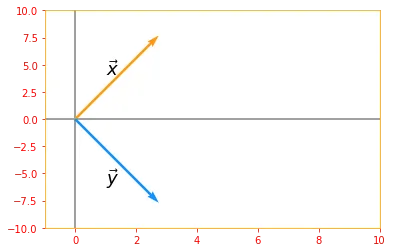
A unit vector is a vector with a unit norm: .
If two vectors are not only are orthogonal but also have unit norm, we call them orthonormal.
A orthogonal matrix is a square matrix whose rows are mutually orthonormal and whose columns are mutually orthonormal:
which implies
so orthogonal matrices are of interest because their inverse is very cheap to compute.
# Lets use sine and cosine to create orthogonal matrixortho_matrix_A = tf.Variable([[tf.cos(.5), -tf.sin(.5)], [tf.sin(.5), tf.cos(.5)]], name="matrixA")print("Matrix A: \n{}\n".format(ortho_matrix_A))
# extract columns from the matrix to verify if they are orthogonalcol_0 = tf.reshape(ortho_matrix_A[:, 0], [2, 1])col_1 = tf.reshape(ortho_matrix_A[:, 1], [2, 1])row_0 = tf.reshape(ortho_matrix_A[0, :], [2, 1])row_1 = tf.reshape(ortho_matrix_A[1, :], [2, 1])
# Verifying if the columns are orthogonalortho_column = tf.tensordot(tf.transpose(col_0), col_1, axes=2)print("Columns are orthogonal: {}".format(ortho_column))plt.rc_context({'axes.edgecolor':'orange', 'xtick.color':'red', 'ytick.color':'red'})origin = [0, 0]plt.xlim(-2, 2)plt.ylim(-3, 4)plt.axvline(x=0, color='grey', zorder=0)plt.axhline(y=0, color='grey', zorder=0)plt.text(0, 2, r'$\vec{col_0}$', size=18)plt.text(0.5, -2, r'$\vec{col_1}$', size=18)plt.quiver(*origin, col_0, col_1, color=['#FF9A13','#FF9A13'], scale=3)
# Verifying if the rows are orthogonalortho_row = tf.tensordot(tf.transpose(row_0), row_1, axes=2)print("Rows are orthogonal: {}\n".format(ortho_row))plt.text(-1, 2, r'$\vec{row_0}$', size=18)plt.text(1, 0.5, r'$\vec{row_1}$', size=18)plt.quiver(*origin, row_0, row_1, color=['r','r'], scale=3)plt.show()
# inverse of matrix Aortho_inverse_A = tf.linalg.inv(ortho_matrix_A)
# Transpose of matrix Aortho_transpose_A = tf.transpose(ortho_matrix_A)
predictor = tf.reduce_all(tf.equal(ortho_inverse_A, ortho_transpose_A))def true_print(): print("Inverse of Matrix A: \n{} \n\nEquals the transpose of Matrix A: \n{}".format(ortho_inverse_A, ortho_transpose_A))def false_print(): print("Inverse of Matrix A: \n{} \n\nDoes not equal the transpose of Matrix A: \n{}".format(ortho_inverse_A, ortho_transpose_A))
tf.cond(predictor, true_print, false_print)
Toggle to see results
Matrix A:<tf.Variable 'matrixA:0' shape=(2, 2) dtype=float32, numpy=array([[ 0.87758255, -0.47942555],       [ 0.47942555,  0.87758255]], dtype=float32)>
Columns are orthogonal: 0.0Rows are orthogonal: 0.0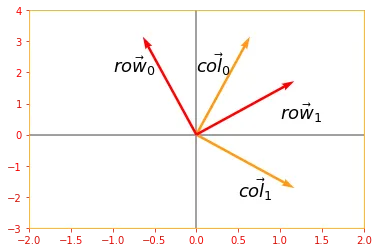
Toggle to see results
Inverse of Matrix A:[[ 0.87758255  0.47942555] [-0.47942555  0.87758255]]
Equals the transpose of Matrix A:[[ 0.87758255  0.47942555] [-0.47942555  0.87758255]]
02.07 - Eigendecomposition
We can represent a number, for example 12 as 12 = 2 x 2 x 3. The representation will change depending on whether we write it in base ten or in binary but the above representation will always be true and from that we can conclude that 12 is not divisible by 5 and that any integer multiple of 12 will be divisible by 3.
Similarly, we can also decompose matrices in ways that show us information about their functional properties that is not obvious from the representation of the matrix as an array of elements. One of the most widely used kinds of matrix decomposition is called eigendecomposition, in which we decompose a matrix into a set of eigenvectors and eigenvalues.
An eigenvector of a square matrix is a nonzero vector such that multiplication by alters only the scale of , in short this is a special vector that doesn’t change the direction of the matrix when applied to it :
The scale is known as the eigenvalue corresponding to this eigenvector.
# Let's see how we can compute the eigen vectors and values from a matrixe_matrix_A = tf.random.uniform([2, 2], minval=3, maxval=10, dtype=tf.float32, name="matrixA")print("Matrix A: \n{}\n\n".format(e_matrix_A))
# Calculating the eigen values and vectors using tf.linalg.eigh, if you only want the values you can use eigvalsheigen_values_A, eigen_vectors_A = tf.linalg.eigh(e_matrix_A)print("Eigen Vectors: \n{} \n\nEigen Values: \n{}\n".format(eigen_vectors_A, eigen_values_A))
# Now lets plot our Matrix with the Eigen vector and see how it looksAv = tf.tensordot(e_matrix_A, eigen_vectors_A, axes=0)vector_plot([tf.reshape(Av, [-1]), tf.reshape(eigen_vectors_A, [-1])], 10, 10)
Toggle to see results
Matrix A:[[5.450138 9.455662] [9.980919 9.223391]]
Eigen Vectors:[[-0.76997876 -0.6380696 ] [ 0.6380696  -0.76997876]]
Eigen Values:[-2.8208985 17.494429 ]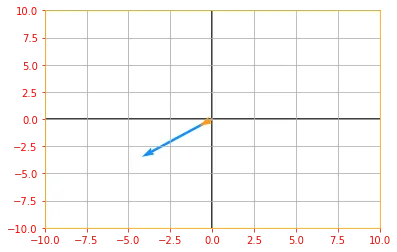
If is an eigenvector of , then so is any rescaled vector for .
# Lets us multiply our eigen vector by a random value s and plot the above graph again to see the rescalingsv = tf.multiply(5, eigen_vectors_A)vector_plot([tf.reshape(Av, [-1]), tf.reshape(sv, [-1])], 10, 10)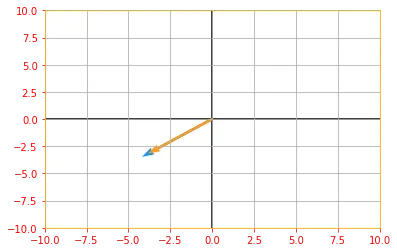
Suppose that a matrix has linearly independent eigenvectors with corresponding eigenvalues . We may concatenate all the eigenvectors to form a matrix with one eigenvector per column: . Likewise, we can concatenate the eigenvalues to form a vector
# Creating a matrix A to find it's decompositioneig_matrix_A = tf.constant([[5, 1], [3, 3]], dtype=tf.float32)new_eigen_values_A, new_eigen_vectors_A = tf.linalg.eigh(eig_matrix_A)
print("Eigen Values of Matrix A: {} \n\nEigen Vector of Matrix A: \n{}\n".format(new_eigen_values_A, new_eigen_vectors_A))
# calculate the diag(lamda)diag_lambda = tf.linalg.diag(new_eigen_values_A)print("Diagonal of Lambda: \n{}\n".format(diag_lambda))
# Find the eigendecomposition of matrix Adecomp_A = tf.tensordot(tf.tensordot(eigen_vectors_A, diag_lambda, axes=1), tf.linalg.inv(new_eigen_vectors_A), axes=1)
print("The decomposition Matrix A: \n{}".format(decomp_A))
Toggle to see results
Eigen Values of Matrix A: [0.8377223 7.1622777]
Eigen Vector of Matrix A:[[-0.5847103   0.81124216] [ 0.81124216  0.5847103 ]]
Diagonal of Lambda:[[0.8377223 0.       ] [0.        7.1622777]]
The decomposition Matrix A:[[-3.3302479 -3.195419 ] [-4.786382  -2.7909322]]
Not every matrix can be decomposed into eigenvalues and eigenvectors. In some cases, the decomposition exists but involves complex rather than real numbers.
In this book, we usually need to decompose only a specific class of matrices that have a simple decomposition. Specifically, every real symmetric matrix can be decomposed into an expression using only real-valued eigenvectors and eigenvalues:
where is an orthogonal matrix composed of eigenvectors of and is a diagonal matrix. The eigenvalue is associated with the eigenvector in column i of , denoted as
# In section 2.6 we manually created a matrix to verify if it is symmetric, but what if we don't know the exact values and want to create a random symmetric matrixnew_matrix_A = tf.Variable(tf.random.uniform([2,2], minval=1, maxval=10, dtype=tf.float32))
# to create an upper triangular matrix from a square oneX_upper = tf.linalg.band_part(new_matrix_A, 0, -1)sym_matrix_A = tf.multiply(0.5, (X_upper + tf.transpose(X_upper)))print("Symmetric Matrix A: \n{}\n".format(sym_matrix_A))
# create orthogonal matrix Q from eigen vectors of Aeigen_values_Q, eigen_vectors_Q = tf.linalg.eigh(sym_matrix_A)print("Matrix Q: \n{}\n".format(eigen_vectors_Q))
# putting eigen values in a diagonal matrixnew_diag_lambda = tf.linalg.diag(eigen_values_Q)print("Matrix Lambda: \n{}\n".format(new_diag_lambda))
sym_RHS = tf.tensordot(tf.tensordot(eigen_vectors_Q, new_diag_lambda, axes=1), tf.transpose(eigen_vectors_Q), axes=1)
predictor = tf.reduce_all(tf.equal(tf.round(sym_RHS), tf.round(sym_matrix_A)))def true_print(): print("It WORKS. \nRHS: \n{} \n\nLHS: \n{}".format(sym_RHS, sym_matrix_A))def false_print(): print("Condition FAILED. \nRHS: \n{} \n\nLHS: \n{}".format(sym_RHS, sym_matrix_A))
tf.cond(predictor, true_print, false_print)
Toggle to see results
Symmetric Matrix A:[[4.517448  3.3404353] [3.3404353 7.411926 ]]
Matrix Q:[[-0.8359252 -0.5488433] [ 0.5488433 -0.8359252]]
Matrix Lambda:[[2.3242188 0.       ] [0.        9.605155 ]]
It WORKS.RHS:[[4.5174475 3.340435 ] [3.340435  7.4119253]]
LHS:[[4.517448  3.3404353] [3.3404353 7.411926 ]]
The eigendecomposition of a matrix tells us many useful facts about the matrix. The matrix is singular if and only if any of the eigenvalues are zero. The eigendecomposition of a real symmetric matrix can also be used to optimize quadratic expressions of the form
The above equation can be solved as following, we know that if is an Eigenvector of and is the corresponding eigenvalue, then , therefore
Whenever is equal to an eigenvector of takes on the value of the corresponding eigenvalue and its minimum value within the constraint region is the minimum eigenvalue.
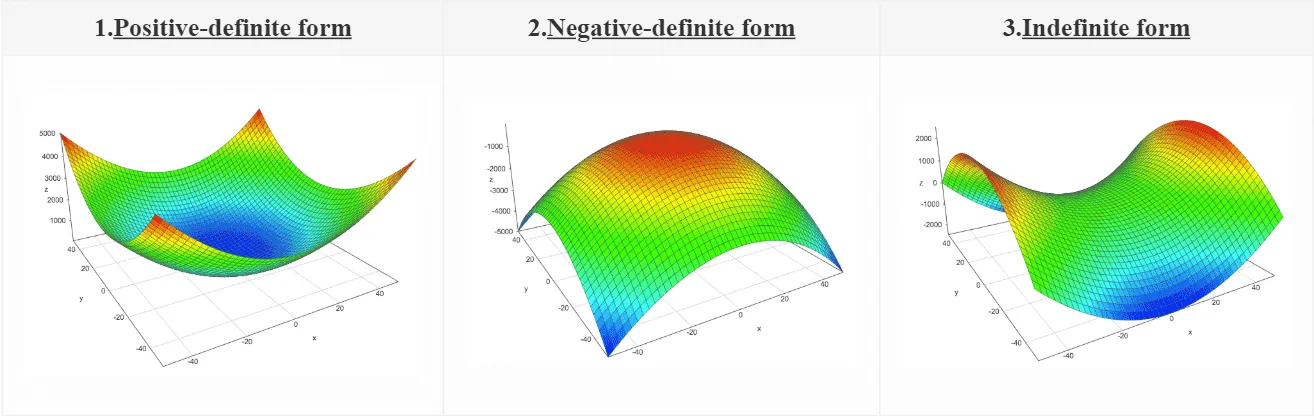
A matrix whose eigenvalues are all positive is called positive definite. A matrix whose eigenvalues are all positive or zero valued is called positive semidefinite. Likewise, if all eigenvalues are negative, the matrix is negative definite, and if all eigenvalues are negative or zero valued, it is negative semidefinite. Positive semidefinite matrices are interesting because they guarantee that
02.08 - Singular Value Decomposition
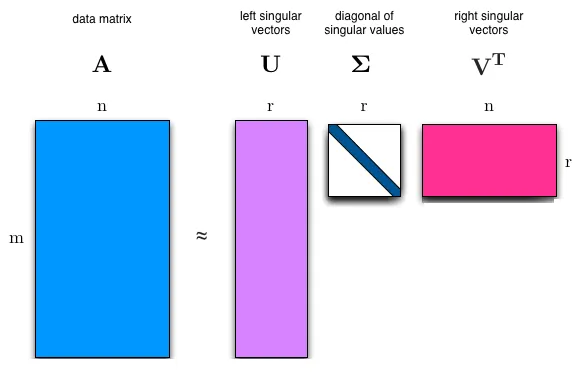
The singular value decomposition (SVD) provides another way to factorize a matrix into singular vectors and singular values. The SVD enables us to discover some of the same kind of information as the eigendecomposition reveals, however, the SVD is more generally applicable. Every real matrix has a singular value decomposition, but the same is not true of the eigenvalue decomposition. SVD can be written as:
Suppose is an m x n matrix, then is defined to be an m x m rotation matrix, to be an m x n matrix scaling & projecting matrix, and to be an n x n rotation matrix.
Each of these matrices is defined to have a special structure. The matrices and are both defined to be orthogonal matrices
The elements along the diagonal of are known as the singular values of the matrix . The columns of are known as the left-singular vectors. The columns of are known as as the right-singular vectors.
# mxn matrix Asvd_matrix_A = tf.constant([[2, 3], [4, 5], [6, 7]], dtype=tf.float32)print("Matrix A: \n{}\n".format(svd_matrix_A))
# Using tf.linalg.svd to calculate the singular value decomposition where d: Matrix D, u: Matrix U and v: Matrix Vd, u, v = tf.linalg.svd(svd_matrix_A, full_matrices=True, compute_uv=True)print("Diagonal D: \n{} \n\nMatrix U: \n{} \n\nMatrix V^T: \n{}".format(d, u, v))
Toggle to see results
Matrix A:[[2. 3.] [4. 5.] [6. 7.]]
Diagonal D:[11.782492    0.41578525]
Matrix U:[[ 0.30449855 -0.86058956  0.40824753] [ 0.54340035 -0.19506174 -0.81649673] [ 0.78230214  0.47046405  0.40824872]]
Matrix V^T:[[ 0.63453555  0.7728936 ] [ 0.7728936  -0.63453555]]
# Lets see if we can bring back the original matrix from the values we have
# mxm orthogonal matrix Usvd_matrix_U = tf.constant([[0.30449855, -0.86058956, 0.40824753], [0.54340035, -0.19506174, -0.81649673], [0.78230214, 0.47046405, 0.40824872]])print("Orthogonal Matrix U: \n{}\n".format(svd_matrix_U))
# mxn diagonal matrix Dsvd_matrix_D = tf.constant([[11.782492, 0], [0, 0.41578525], [0, 0]], dtype=tf.float32)print("Diagonal Matrix D: \n{}\n".format(svd_matrix_D))
# nxn transpose of matrix Vsvd_matrix_V_trans = tf.constant([[0.63453555, 0.7728936], [0.7728936, -0.63453555]], dtype=tf.float32)print("Transpose Matrix V: \n{}\n".format(svd_matrix_V_trans))
# UDV(^T)svd_RHS = tf.tensordot(tf.tensordot(svd_matrix_U, svd_matrix_D, axes=1), svd_matrix_V_trans, axes=1)
predictor = tf.reduce_all(tf.equal(tf.round(svd_RHS), svd_matrix_A))def true_print(): print("It WORKS. \nRHS: \n{} \n\nLHS: \n{}".format(tf.round(svd_RHS), svd_matrix_A))def false_print(): print("Condition FAILED. \nRHS: \n{} \n\nLHS: \n{}".format(tf.round(svd_RHS), svd_matrix_A))
tf.cond(predictor, true_print, false_print)Toggle to see results
Orthogonal Matrix U:[[ 0.30449855 -0.86058956  0.40824753] [ 0.54340035 -0.19506174 -0.81649673] [ 0.78230214  0.47046405  0.40824872]]
Diagonal Matrix D:[[11.782492    0.        ] [ 0.          0.41578525] [ 0.          0.        ]]
Transpose Matrix V:[[ 0.63453555  0.7728936 ] [ 0.7728936  -0.63453555]]
It WORKS.RHS:[[2. 3.] [4. 5.] [6. 7.]]
LHS:[[2. 3.] [4. 5.] [6. 7.]]
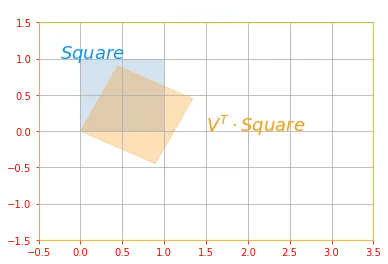
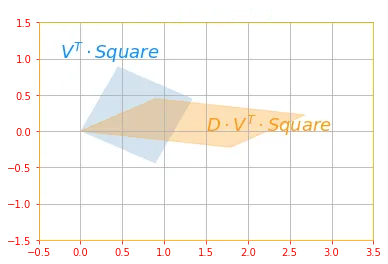
Matrix can be seen as a linear transformation. This transformation can be decomposed into three sub-transformations:
- Rotation,
- Re-scaling and projecting,
- Rotation.
These three steps correspond to the three matrices
Let’s see how these transformations are taking place in order
# Let's define a unit squaresvd_square = tf.constant([[0, 0, 1, 1],[0, 1, 1, 0]], dtype=tf.float32)
# a new 2x2 matrixsvd_new_matrix = tf.constant([[1, 1.5], [0, 1]])
# SVD for the new matrixnew_d, new_u, new_v = tf.linalg.svd(svd_new_matrix, full_matrices=True, compute_uv=True)
# lets' change d into a diagonal matrixnew_d_marix = tf.linalg.diag(new_d)
# Rotation: V^T for a unit squareplot_transform(svd_square, tf.tensordot(new_v, svd_square, axes=1), "$Square$", "$V^T \cdot Square$", "Rotation", axis=[-0.5, 3.5 , -1.5, 1.5])plt.show()
# Scaling and Projecting: DV^(T)plot_transform(tf.tensordot(new_v, svd_square, axes=1), tf.tensordot(new_d_marix, tf.tensordot(new_v, svd_square, axes=1), axes=1), "$V^T \cdot Square$", "$D \cdot V^T \cdot Square$", "Scaling and Projecting", axis=[-0.5, 3.5 , -1.5, 1.5])plt.show()
# Second Rotation: UDV^(T)trans_1 = tf.tensordot(tf.tensordot(new_d_marix, new_v, axes=1), svd_square, axes=1)trans_2 = tf.tensordot(tf.tensordot(tf.tensordot(new_u, new_d_marix, axes=1), new_v, axes=1), svd_square, axes=1)plot_transform(trans_1, trans_2,"$U \cdot D \cdot V^T \cdot Square$", "$D \cdot V^T \cdot Square$", "Second Rotation", color=['#1190FF', '#FF9A13'], axis=[-0.5, 3.5 , -1.5, 1.5])plt.show()
Toggle to see results
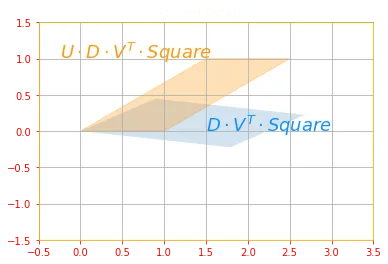
The above sub transformations can be found for each matrix as follows:
- corresponds to the eigenvectors of
- corresponds to the eigenvectors of
- corresponds to the eigenvaluesorwhich are the same.
As an exercise try proving this is the case.
Perhaps the most useful feature of the SVD is that we can use it to partially generalize matrix inversion to nonsquare matrices, as we will see in the next section.
02.09 - The Moore-Penrose Pseudoinverse
Matrix inversion is not defined for matrices that are not square. Suppose we want to make a left-inverse of a matrix so that we can solve a linear equation by left multiplying each side to obtain .
Depending on the structure of the problem, it may not be possible to design a unique mapping from to .
The Moore-Penrose pseudoinverse enables use to make some headway in these cases. The pseudoinverse of is defined as a matrix:
Practical algorithms for computing the pseudoinverse are based not on this definition, but rather on the formula:
where and are the singular decomposition of and the pseudoinverse of of a diagonal matrix is obtained by taking the reciprocal of its nonzero elements then taking the transpose of the resulting matrix.
# Matrix Ampp_matrix_A = tf.random.uniform([3, 2], minval=1, maxval=10, dtype=tf.float32)print("Matrix A: \n{}\n".format(mpp_matrix_A))
# Singular Value decomposition of matrix Ampp_d, mpp_u, mpp_v = tf.linalg.svd(mpp_matrix_A, full_matrices=True, compute_uv=True)print("Matrix U: \n{} \n\nMatrix V: \n{}\n".format(mpp_u, mpp_v))
# pseudo inverse of matrix Dd_plus = tf.concat([tf.transpose(tf.linalg.diag(tf.math.reciprocal(mpp_d))), tf.zeros([2, 1])], axis=1)print("D plus: \n{}\n".format(d_plus))
# moore-penrose pseudoinverse of matrix Amatrix_A_star = tf.matmul(tf.matmul(mpp_v, d_plus, transpose_a=True), mpp_u, transpose_b=True)
print("The Moore-Penrose pseudoinverse of Matrix A: \n{}".format(matrix_A_star))
Toggle to see results
Matrix A:[[6.1130576 2.7441363] [8.039717  5.8797803] [9.662358  8.468619 ]]
Matrix U:[[ 0.3731766  -0.8532468   0.36429217] [ 0.56925267 -0.09947323 -0.8161228 ] [ 0.7325915   0.51193243  0.44859198]]
Matrix V:[[ 0.79661715 -0.60448414] [ 0.60448414  0.79661715]]
D plus:[[0.05716072 0.         0.        ] [0.         0.5653558  0.        ]]
The Moore-Penrose pseudoinverse of Matrix A:[[-0.27460322 -0.0080738   0.2083109 ] [-0.39717284 -0.06446922  0.20524703]]
When has more columns than rows, then solving a linear equation using the pseudoinverse provides one of the many possible solutions. Specifically, it provides the solution with minimal Euclidean norm among all possible solutions.
mpp_vector_y = tf.constant([[2], [3], [4]], dtype=tf.float32)print("Vector y: \n{}\n".format(mpp_vector_y))
mpp_vector_x = tf.matmul(matrix_A_star, mpp_vector_y)print("Vector x: \n{}".format(mpp_vector_x))
Toggle to see results
Vector y:[[2.] [3.] [4.]]
Vector x:[[ 0.2598158 ] [-0.16676521]]
When has more rows than columns, it is possible for there to be no solution. In this case, using the pseudoinverse gives us the for which is as close as possible to in terms of Euclidean norm
Stay in the loop
Notes from the trenches on building, scaling, and shipping production ML systems.
Occasional emails. Only when there's something worth sharing.
02.10 - The Trace Operator
The trace operator gives the sum of all the diagonal entries of a matrix:
# random 3x3 matrix Ato_matrix_A = tf.random.uniform([3, 3], minval=0, maxval=10, dtype=tf.float32)
# trace of matrix A using tf.linalg.tracetrace_matrix_A = tf.linalg.trace(to_matrix_A)
print("Trace of Matrix A: \n{} \nis: {}".format(to_matrix_A, trace_matrix_A))
Toggle to see results
Trace of Matrix A:[[1.0423017 9.2543545 9.264312 ] [8.952941 8.2056675 4.0400686] [8.285712 6.5746584 8.217355 ]]is: 17.46532440185547The trace operator is useful for a variety of reasons. Some operations that are difficult to specify without resorting to summation notation can be specified using matrix products and the trace operator. For example, the trace operator provides an alternative way of writing the Frobenius norm of a matrix:
# Frobenius Norm of Afrobenius_A = tf.norm(to_matrix_A)
# sqrt(Tr(A times A^T))trace_rhs = tf.sqrt(tf.linalg.trace(tf.matmul(to_matrix_A, to_matrix_A, transpose_b=True)))
predictor = tf.equal(tf.round(frobenius_A), tf.round(trace_rhs))def true_print(): print("It WORKS. \nRHS: {} \nLHS: {}".format(frobenius_A, trace_rhs))def false_print(): print("Condition FAILED. \nRHS: {} \nLHS: {}".format(frobenius_A, trace_rhs))
tf.cond(predictor, true_print, false_print)
Toggle to see results
It WORKS.RHS: 22.71059799194336LHS: 22.710599899291992Writing an expression in terms of the trace operator opens up opportunities to manipulate the expression using many useful identities. For example, the trace operator is invariant to the transpose operator:
# Transpose of Matrix Atrans_matrix_A = tf.transpose(to_matrix_A)
#Trace of the transpose Matrix Atrace_trans_A = tf.linalg.trace(trans_matrix_A)
predictor = tf.equal(trace_matrix_A, trace_trans_A)def true_print(): print("It WORKS. \nRHS: {} \nLHS: {}".format(trace_matrix_A, trace_trans_A))def false_print(): print("Condition FAILED. \nRHS: {} \nLHS: {}".format(trace_matrix_A, trace_trans_A))
tf.cond(predictor, true_print, false_print)
Toggle to see results
It WORKS.RHS: 17.46532440185547LHS: 17.46532440185547The trace of a square matrix composed of many factors is also invariant to moving the last factor into the first position, if the shapes of the corresponding matrices allow the resulting product to be defined:
# random 3x3 matrix B and matrix Cto_matrix_B = tf.random.uniform([3, 3], minval=0, maxval=10, dtype=tf.float32)to_matrix_C = tf.random.uniform([3, 3], minval=0, maxval=10, dtype=tf.float32)
# ABCabc = tf.tensordot((tf.tensordot(to_matrix_A, to_matrix_B, axes=1)), to_matrix_C, axes=1)
# CABcab = tf.tensordot((tf.tensordot(to_matrix_C, to_matrix_A, axes=1)), to_matrix_B, axes=1)
# BCAbca = tf.tensordot((tf.tensordot(to_matrix_B, to_matrix_C, axes=1)), to_matrix_A, axes=1)
# trace of matrix ABC, CAB and matrix BCAtrace_matrix_abc = tf.linalg.trace(abc)trace_matrix_cab = tf.linalg.trace(cab)trace_matrix_bca = tf.linalg.trace(bca)
predictor = tf.equal(tf.round(trace_matrix_abc), tf.round(trace_matrix_cab)) and tf.equal(tf.round(trace_matrix_cab), tf.round(trace_matrix_bca))def true_print(): print("It WORKS. \nABC: {} \nCAB: {} \nBCA: {}".format(trace_matrix_abc, trace_matrix_cab, trace_matrix_bca))def false_print(): print("Condition FAILED. \nABC: {} \nCAB: {} \nBCA: {}".format(trace_matrix_abc, trace_matrix_cab, trace_matrix_bca))
tf.cond(predictor, true_print, false_print)
Toggle to see results
It WORKS.ABC: 5854.24609375CAB: 5854.24609375BCA: 5854.24609375This invariance to cyclic permutation holds even if the resulting product has a different shape. For example, for
# mxn matrix Ato_new_matrix_A = tf.random.uniform([3, 2], minval=0, maxval=10, dtype=tf.float32)print(" 3x2 Matrix A: \n{}\n".format(to_new_matrix_A))
# mxn matrix Bto_new_matrix_B = tf.random.uniform([2, 3], minval=0, maxval=10, dtype=tf.float32)print(" 3x2 Matrix B: \n{}\n".format(to_new_matrix_B))
# trace of matrix AB and BAab = tf.linalg.trace(tf.matmul(to_new_matrix_A, to_new_matrix_B))ba = tf.linalg.trace(tf.matmul(to_new_matrix_B, to_new_matrix_A))
predictor = tf.equal(tf.round(ab), tf.round(ba))def true_print(): print("It WORKS. \nAB: {} \nBA: {}".format(ab, ba))def false_print(): print("Condition FAILED. \nAB: {} \nBA: {}".format(ab, ba))
tf.cond(predictor, true_print, false_print)
Toggle to see results
3x2 Matrix A:[[1.4351392  2.850753  ] [3.6514747  7.5348463 ] [4.881668   0.43383718]]
3x2 Matrix B:[[1.7338943 9.986754  8.326568 ] [6.2179327 3.0207145 8.137293 ]]
It WORKS.AB: 123.61897277832031BA: 123.61897277832031
02.11 - The Determinant
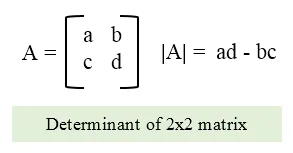
The determinant of a square matrix, denoted det(), is a function that maps matrices to real scalars. You can calculate the determinant of a 2 x 2 matrix as:
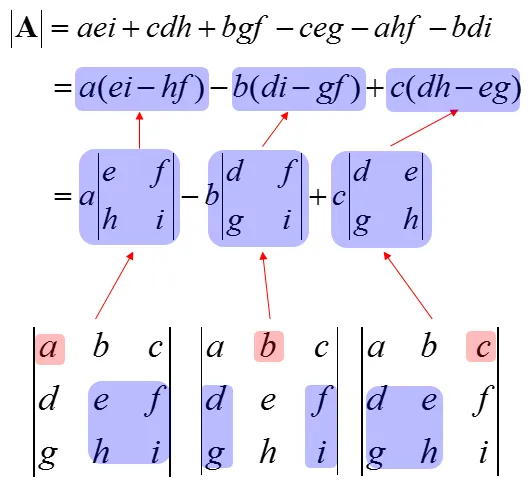
For a 3 x 3 matrix:
# calculate det of a matrixdet_matrix_A = tf.constant([[3,1], [0,3]], dtype=tf.float32)det_A = tf.linalg.det(det_matrix_A)print("Matrix A: \n{} \nDeterminant of Matrix A: \n{}".format(det_matrix_A, det_A))
vector_plot(det_matrix_A, 5, 5)
Toggle to see results
Matrix A:[[3. 1.] [0. 3.]]Determinant of Matrix A: 9.0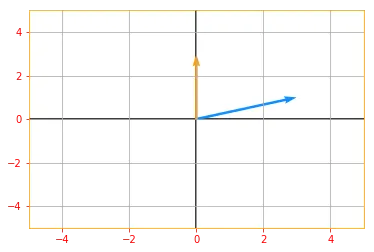
The determinant is equal to the product of all the eigenvalues of the matrix.
# Let's find the eigen values of matrix Ad_eigen_values = tf.linalg.eigvalsh(det_matrix_A)eigvalsh_product = tf.multiply(d_eigen_values[0], d_eigen_values[1])
# lets validate if the product of the eigen values is equal to the determinantpredictor = tf.equal(eigvalsh_product, det_A)def true_print(): print("It WORKS. \nRHS: \n{} \n\nLHS: \n{}".format(eigvalsh_product, det_A))def false_print(): print("Condition FAILED. \nRHS: \n{} \n\nLHS: \n{}".format(eigvalsh_product, det_A))
tf.cond(predictor, true_print, false_print)
Toggle to see results
It WORKS.RHS:9.0
LHS:9.0
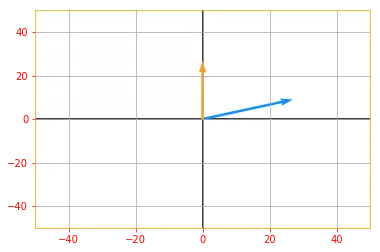
The absolute value of the determinant can be thought of as a measure of how much multiplication by the matrix expands or contracts space. If the determinant is 0, then space is contracted completely along at least one dimension, causing it to lose all its volume. If the determinant is 1, then the transformation preserves volume.
# If you see the following plot, you can see the vectors are expanded
vector_plot(tf.multiply(tf.abs(det_A), det_matrix_A), 50, 50)
Toggle to see results
02.12 - Example: Principal Components Analysis
PCA is a complexity reduction technique that tries to reduce a set of variables down to a smaller set of components that represent most of the information in the variables. This can be thought of as for a collection of data points applying lossy compression, meaning storing the points in a way that require less memory by trading some precision. At a conceptual level, PCA works by identifying sets of variables that share variance, and creating a component to represent that variance.
Earlier, when we were doing transpose or the matrix inverse, we relied on using Tensorflow’s built in functions but for PCA, there is no such function, except one in the Tensorflow Extended (tft).
There are multiple ways you can implement a PCA in Tensorflow but since this algorithm is such an important one in the machine learning world, we will take the long route.
The reason for having PCA under Linear Algebra is to show that PCA could be implemented using the theorems we studied in this Chapter.
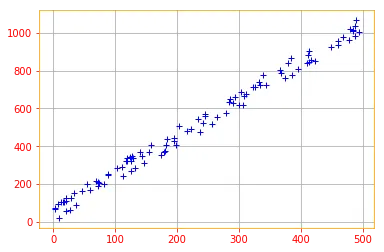
# To start working with PCA, let's start by creating a 2D data set
x_data = tf.multiply(5, tf.random.uniform([100], minval=0, maxval=100, dtype = tf.float32, seed = 0))y_data = tf.multiply(2, x_data) + 1 + tf.random.uniform([100], minval=0, maxval=100, dtype = tf.float32, seed = 0)
X = tf.stack([x_data, y_data], axis=1)
plt.rc_context({'axes.edgecolor':'orange', 'xtick.color':'red', 'ytick.color':'red'})plt.plot(X[:,0], X[:,1], '+', color='b')plt.grid()
Toggle to see results
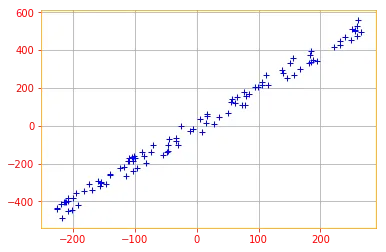
We start by standardizing the data. Even though the data we created are on the same scales, its always a good practice to start by standardizing the data because most of the time the data you will be working with will be in different scales.
def normalize(data):    # creates a copy of data    X = tf.identity(data)    # calculates the mean    X -=tf.reduce_mean(data, axis=0)    return X
normalized_data = normalize(X)plt.plot(normalized_data[:,0], normalized_data[:,1], '+', color='b')plt.grid()
Toggle to see results
Recall that PCA can be thought of as applying lossy compression to a collection of data points. The way we can minimize the loss of precision is by finding some decoding function where will be the corresponding vector.
PCA is defined by our choice of this decoding function. Specifically, to make the decoder very simple, we chose to use matrix multiplication to map and define . Our goal is to minimize the distance between the input point to its reconstruction and to do that we use norm. Which boils down to our encoding function
Finally, to reconstruct the PCA we use the same matrix to decode all the points and to solve this optimization problem, we use eigendecomposition.
Please note that the following equation is the final version of a lot of matrix transformations. I don’t provide the derivatives because the goal is to focus on the mathematical implementation, rather than the derivation. But for the curious, You can read about the derivation in Chapter 2 Section 11.
To find we can calculate the eigenvectors .
# Finding the Eigne Values and Vectors for the dataeigen_values, eigen_vectors = tf.linalg.eigh(tf.tensordot(tf.transpose(normalized_data), normalized_data, axes=1))
print("Eigen Vectors: \n{} \nEigen Values: \n{}".format(eigen_vectors, eigen_values))
Toggle to see results
Eigen Vectors:[[-0.8908606 -0.45427683][ 0.45427683 -0.8908606 ]]Eigen Values:[ 16500.715 11025234. ]The eigenvectors (principal components) determine the directions of the new feature space, and the eigenvalues determine their magnitude.
Now, let’s use these Eigenvectors to rotate our data. The goal of the rotation is to end up with a new coordinate system where data is uncorrelated and thus where the basis axes gather all the variance. Thereby reducing the dimension.
Recall our encoding function
X_new = tf.tensordot(tf.transpose(eigen_vectors), tf.transpose(normalized_data), axes=1)
plt.plot(X_new[0, :], X_new[1, :], '+', color='b')plt.xlim(-500, 500)plt.ylim(-700, 700)plt.grid()
Toggle to see results
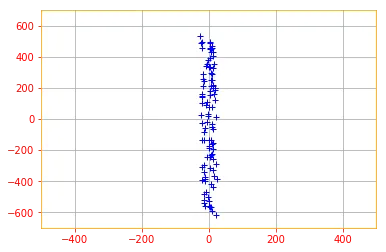
That is the transformed data and that’s it folks for our chapter on Linear Algebra 😉.
💫 Congratulations
You have successfully completed Chapter 2 Linear algebra of Deep Learning with Tensorflow 2.0. To recap, we went through the following concepts:
- Scalars, Vectors, Matrices and Tensors
- Multiplying Matrices and Vectors
- Identity and Inverse Matrices
- Linear Dependence and Span
- Norms
- Special Kinds of Matrices and Vectors
- Eigendecomposition
- Singular Value Decomposition
- The Moore-Penrose Pseudoinverse
- The Trace Operator
- The Determinant
- Example: Principal Components Analysis
We covered a lot of content in one notebook, like I mentioned in the begining, this is not meant to be an absolute beginner or a comprehensive chapter on Linear Algebra, our focus is Deep Learning with Tensorflow, so we only went through the material we need to understand Deep Learning.
I tried to minimize the mathematics and focus more on the implementation side but if you like to study linear algebra on all of it’s glory, or just want to read more about few sections take a look at Linear Algebra by Jim Hefferon or A First Course in Linear Algebra by Robert A. Beezer.
🔥 You can access the Code for this notebook in GitHub or launch an executable versions using Google Colab or view it in Jupyter nbviewer. 🔥
Enjoyed this post?
Leave a quick reaction or share it with someone who might find it useful.